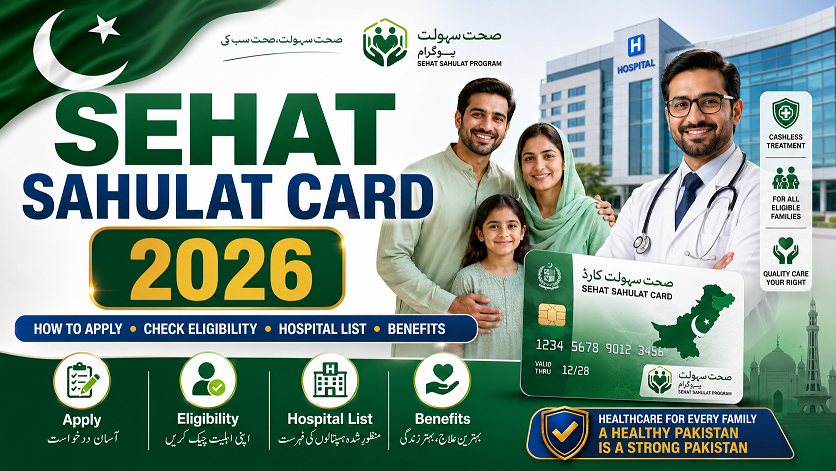
The Sehat Sahulat Card gives eligible Pakistani families free medical treatment up to Rs. 10 Lakh (1 million) per year at over 1,200 empaneled hospitals across Pakistan. To check if you are eligible: send your 13-digit CNIC number to 8500 via SMS — you get an instant reply. No physical card is needed — just your CNIC. The program covers major surgeries, cancer treatment, cardiac procedures, dialysis, kidney transplant, maternity care, and emergency treatment. Outpatient (OPD) visits are generally not covered. Coverage is active in Punjab, KP, Islamabad, AJK, and Gilgit-Baltistan.
The Sehat Sahulat Card is Pakistan’s flagship health insurance and welfare program aimed at providing quality medical care to families without financial burden. With medical costs rising sharply in 2026, this program has become one of the most critical government services for Pakistani families — yet millions of eligible families either do not know they are enrolled or do not know how to use it.
This guide tells you in plain language exactly how to check your eligibility, what the card covers, which hospitals accept it, and precisely how to use it when you arrive at a hospital — all in one place.
What is the Sehat Sahulat Card? (صحت سہولت کارڈ)
Under this initiative, eligible citizens can receive free or cashless treatment up to Rs. 1,000,000 (10 Lakh) per family per year at empaneled public and private hospitals across the country. This initiative helps millions of Pakistanis access lifesaving medical services such as surgeries, maternity care, cancer treatment, emergency care, and diagnostic support — without out-of-pocket payments.
The program is implemented differently across provinces. In Punjab it is managed by the Punjab Health Initiative Management Company (PHIMC). In KP it is managed by the provincial health department. Federally it is administered under the Prime Minister’s Health Program. Despite different administrators, the core benefit — Rs. 10 Lakh annual family coverage at empaneled hospitals — is consistent across all covered regions.
| Feature | Detail 2026 |
|---|---|
| Annual coverage limit | Rs. 10,00,000 (10 Lakh) per family per year |
| Type of insurance | Government-funded health insurance — no premium paid by beneficiary |
| Physical card required? | No — CNIC is sufficient at most hospitals |
| Verification method | Biometric thumbprint at hospital health desk |
| Coverage type | Inpatient (IPD) — hospitalisation and surgery only (not OPD) |
| Number of hospitals | 1,200+ empaneled across Pakistan (updated 2026) |
| Eligibility basis | Household socioeconomic assessment via NADRA data — most auto-enrolled |
| Official portal | pmhealthprogram.gov.pk |
How to Check Your Eligibility — SMS, Online & App
Most eligible families are automatically enrolled based on NADRA household data — you do not need to apply manually. Check if your family is already enrolled using any of these three methods:
Works on any mobile network (Jazz, Telenor, Ufone, Zong, SCO)
Method 2 — Check Online
Visit Official Portal
Go to pmhealthprogram.gov.pk on your mobile or computer browser. For Punjab specifically, also check phimc.punjab.gov.pk. Look for the “Check Eligibility” or “CNIC Verification” section on the homepage.
Enter Your CNIC
Type your 13-digit CNIC number (without dashes) in the search box and click Search or Submit. The system shows your enrollment status, the eligible family members covered, and your nearest empaneled hospitals.
Method 3 — Mobile App
Download the ‘Naya Pakistan Qaumi Sehat Card’ app — available on Google Play Store and App Store. The app allows you to check eligibility, find nearby empaneled hospitals, and track your family’s remaining annual coverage balance. It is available in Urdu and English.
If Your CNIC Shows “Not Enrolled” — What to Do
If the SMS or portal shows you are not enrolled, it does not necessarily mean you are ineligible. NADRA data may not yet reflect your household. Visit your nearest Sehat Sahulat Centre (locations at pmhealthprogram.gov.pk) with your original CNIC and request manual enrollment assessment. Bring your family’s CNIC cards and any proof of household income (utility bills, rent receipts). Registration is completely free — never pay anyone to enroll you.
What Does the Sehat Card Cover in 2026?
The updated hospital list includes facilities specialising in high-cost treatments, fully covered by the Sehat Card. Here is the complete breakdown of what is and is not included:
| Procedure / Treatment | Covered? | Notes |
|---|---|---|
| Cardiac — Angioplasty | Yes | At approved cardiac centres only |
| Cardiac — Bypass Surgery (CABG) | Yes | Covered at approved hospitals |
| Cardiac — Stents | Yes | Within annual limit |
| Cancer — Chemotherapy | Yes | At approved oncology centres |
| Cancer — Radiotherapy | Yes | At approved oncology centres |
| Cancer — Surgery | Yes | Covered as inpatient surgery |
| Kidney — Dialysis | Yes | At approved dialysis centres |
| Kidney — Transplant | Yes | At specifically approved transplant centres only |
| Maternity — Normal Delivery | Yes | Covered as inpatient admission |
| Maternity — C-Section | Yes | Covered as inpatient surgery |
| General Surgery | Yes | Appendectomy, hernia, gallbladder, etc. |
| Emergency Treatment (any empaneled hospital) | Yes | In emergencies, you can visit any empaneled hospital regardless of your home district |
| Outpatient (OPD) Doctor Visits | No | Not covered for general public |
| Medicines prescribed at OPD | No | Pay out of pocket |
| Dental treatment | No | Not covered |
| Cosmetic procedures | No | Not covered |
| Glasses / eyecare | No | Not covered |
What Is NOT Covered — Important Exclusions
Understanding what the Sehat Card does NOT cover is as important as knowing what it covers — especially before you visit a hospital expecting free treatment:
- Outpatient (OPD) visits: Outpatient (OPD) visits are generally not covered for the general public — you pay the doctor’s consultation fee yourself
- Medicines for chronic conditions: Daily medicines for diabetes, blood pressure, heart conditions — paid out of pocket at OPD level
- Non-empaneled hospitals: You cannot use the Sehat Card at a hospital not on the approved panel list — always verify before visiting
- Cosmetic or elective procedures: Any treatment that is not medically necessary
- Dental treatment: Not covered under the standard program
- Treatment abroad: Only valid at empaneled hospitals within Pakistan
- Amount above Rs. 10 Lakh: Any treatment cost exceeding the annual Rs. 10 Lakh family limit is paid by the patient
Always Confirm Hospital Empaneled Status Before Visiting
The government updates the panel hospital list regularly. A hospital that was on the list in 2025 may have been removed in 2026, or a new hospital may have been added near you. Always verify a hospital’s current status at pmhealthprogram.gov.pk or via the official app before travelling for planned treatment. In emergencies, you can go to any empaneled hospital — staff at the health desk will verify in real time.
Province-by-Province Coverage Guide
The Punjab Sehat Card Scheme 2026 continues to transform free medical treatment in Punjab by offering cashless healthcare services to eligible families. Punjab has the largest network of empaneled hospitals. Most eligible families auto-enrolled via BISP and NADRA data.
KP was the first province to launch the Sehat Card under the 2016 PTI government. Universal coverage — all KP families enrolled regardless of income. Check via SMS 8500 or KP Health Department portal.
As long as your CNIC is valid and shows Islamabad as your permanent address, you are entitled to free treatment up to PKR 10 Lakh. Both PIMS and Polyclinic are included alongside major private hospitals.
AJK and Gilgit-Baltistan are covered under the federal Sehat Sahulat Program. Hospital network is smaller than Punjab but key district hospitals are empaneled. Check SMS 8500 for eligibility.
Sindh and Balochistan — Separate Schemes
Sindh has its own scheme called Sehat Card Plus implemented by the Sindh government. Balochistan has a separate provincial health program. If you are a Sindh or Balochistan resident, check at sehatsindh.gov.pk or your district health office for current coverage details. The federal Sehat Sahulat Card (SMS 8500) covers Punjab, KP, ICT, AJK, and GB — not Sindh or Balochistan under the same system.
Empaneled Hospital List 2026 — By City
With more than 1,200 empaneled hospitals nationwide, the Sehat Sahulat Program continues to provide lifesaving care. Below are key hospitals by city — for the complete updated list, always download the official PDF at pmhealthprogram.gov.pk or check the mobile app.
- GovtPakistan Institute of Medical Sciences (PIMS), G-8/3
- GovtFederal Government Polyclinic Hospital (FGPC), G-6/2
- PrivateShifa International Hospital (category-based access — verify before visiting)
- PrivateMaroof International Hospital (limited/category-based — verify first)
- PrivateIslamabad Diagnostic Centre (for in-patient diagnostics)
- GovtMayo Hospital, Lahore
- GovtLahore General Hospital
- GovtServices Hospital, Lahore
- PrivateIttefaq Hospital Trust, Lahore
- PrivateCh. Rahmat Ali Memorial Trust Hospital
- PrivateIsra Islamic Foundation G. Limited
- GovtCivil Hospital Karachi
- GovtJinnah Postgraduate Medical Centre (JPMC)
- PrivateAga Khan University Hospital (selected services)
- PrivateLiaquat National Hospital
- GovtLady Reading Hospital (LRH), Peshawar
- GovtHayatabad Medical Complex
- GovtKhyber Teaching Hospital
- PrivateNorthwest General Hospital & Research Centre
- GovtHoly Family Hospital, Rawalpindi
- GovtRawalpindi General Hospital (RGH)
- PrivateGovt Mian Meer Hospital
How to Find Your Nearest Empaneled Hospital
The most reliable way to find empaneled hospitals near you: (1) Open the Naya Pakistan Qaumi Sehat Card app → tap “Find Hospital” → allow location access → the app shows all empaneled hospitals within your radius. (2) Visit pmhealthprogram.gov.pk → Hospital List → select your district → download the PDF. (3) Call the helpline 0800-44444 (free) and provide your district — the operator will list nearby empaneled hospitals. Always verify the hospital’s current status on the day you plan to visit, as the list updates regularly.
How to Use Sehat Card at Hospital — Step by Step
Using the Sehat Card is simpler than most people expect. Visit any empaneled hospital, show your card or CNIC, and get treatment for free. Here is the detailed process:
Confirm the Hospital is Empaneled
Before travelling to any hospital for planned treatment, verify it is currently on the empaneled list at pmhealthprogram.gov.pk or via the app. In an emergency, go to the nearest empaneled hospital — you can go to any empaneled hospital in Pakistan regardless of your home district in emergency situations.
Go to the Health Desk / Sehat Card Counter at Reception
Every empaneled hospital has a dedicated Sehat Card Health Desk — usually near the main reception or emergency entrance. Tell the staff you are a Sehat Card beneficiary. Do not go to the general cashier or OPD counter first — go directly to the Health Desk.
Present Your Original CNIC and Do Biometric Verification
If eligible, visit any empaneled hospital, present your CNIC at the health desk, and after verification, you can receive treatment without payment. The health desk staff will scan your thumbprint on a biometric device connected to NADRA. This verifies your identity and confirms your enrollment in real time. If the biometric fails (due to worn fingerprints or skin condition), staff can use alternate NADRA verification methods.
Receive Treatment Without Payment
Once verified, you are admitted and treated without paying. The hospital bills the government directly. All medicines, procedures, room charges, and surgical fees during your inpatient admission are covered up to the Rs. 10 Lakh annual limit. Keep a copy of your admission slip and discharge summary — you may need these if any billing dispute arises.
Referral for Specialised Treatment
If advanced treatment is not available in your district, the hospital will officially refer you to a tertiary care centre in a major city. This referral is handled through the Sehat Card system — do not travel to a major city hospital without a formal referral letter from the referring hospital, as walk-in access to tertiary centres requires proper referral documentation.
How to Register If You Are Not Yet Enrolled
Most families are automatically enrolled under the Sehat Sahulat health insurance system without manual registration. However, if you check via SMS 8500 and find you are not enrolled, follow these steps:
- Visit your nearest Sehat Sahulat Centre — locations listed at pmhealthprogram.gov.pk
- Bring original CNICs of all adult family members and B-Forms for children
- Staff conduct a basic household assessment to determine eligibility
- If eligible, enrollment is processed on the spot — typically takes 1–3 business days to activate
- Registration is completely free — do not pay any third party claiming to register you faster
- For Punjab: visit your nearest PHIMC district office or call 0800-44444
- You can also download the official app and apply through the “Register” option for new enrollment requests
Helpline Numbers & Official Websites
Official Websites
- Federal: pmhealthprogram.gov.pk — eligibility check, hospital list, official info
- Punjab: phimc.punjab.gov.pk — Punjab-specific hospital list and enrollment
- Sindh (Sehat Card Plus): sehatsindh.gov.pk
- Mobile App: “Naya Pakistan Qaumi Sehat Card” — available on Google Play Store and App Store
Urdu Summary — صحت سہولت کارڈ 2026
صحت سہولت کارڈ — مکمل رہنما 2026
صحت سہولت کارڈ پاکستانی خاندانوں کو ہر سال 10 لاکھ روپے تک مفت علاج کی سہولت دیتا ہے۔ 1,200 سے زیادہ سرکاری اور نجی ہسپتال اس پروگرام میں شامل ہیں۔
- اہلیت چیک کریں: اپنا 13 ہندسی CNIC نمبر 8500 پر SMS کریں — مفت، فوری جواب
- کوئی فزیکل کارڈ نہیں: صرف CNIC لے کر قریب ترین حامی ہسپتال آئیں
- علاج میں شامل: دل کی سرجری، کینسر، ڈائیلیسس، زچگی، ایمرجنسی
- شامل نہیں: OPD وزٹ، روزانہ کی دوائیں، دانتوں کا علاج
- ہسپتال میں کیا کریں: Health Desk پر جائیں ← CNIC دکھائیں ← انگوٹھا لگائیں ← مفت علاج پائیں
- پنجاب: phimc.punjab.gov.pk | وفاقی: pmhealthprogram.gov.pk
- ہیلپ لائن: 0800-44444 (مفت، 24/7)
- ایپ: “Naya Pakistan Qaumi Sehat Card” — گوگل پلے اور ایپ اسٹور پر
اگر آپ کا CNIC رجسٹرڈ نہیں تو قریبی صحت سہولت سینٹر جائیں — رجسٹریشن بالکل مفت ہے۔
Frequently Asked Questions
How do I check if I am eligible for the Sehat Sahulat Card in 2026?
The fastest method: send your 13-digit CNIC number as an SMS to 8500 from any mobile phone. You will receive a reply within minutes confirming whether your family is enrolled. You can also check online at pmhealthprogram.gov.pk or via the Naya Pakistan Qaumi Sehat Card mobile app. Most families are automatically enrolled under the Sehat Sahulat health insurance system without manual registration — based on NADRA household data.
How much free treatment does the Sehat Sahulat Card cover in 2026?
The Sehat Sahulat Card covers free medical treatment up to Rs. 1,000,000 (10 Lakh) per family per year at empaneled hospitals. This covers major inpatient treatments including surgeries, cancer treatment, cardiac procedures, dialysis, kidney transplant, maternity care, and emergency treatment. Outpatient doctor visits and daily medicines are generally not covered.
How do I use the Sehat Sahulat Card at a hospital?
Visit any empaneled hospital, go to the Health Desk or Sehat Card counter at reception, present your original CNIC, undergo biometric thumbprint verification, and receive treatment without any payment. If eligible, you can receive treatment without payment — the hospital bills the government directly. No physical Sehat Card is needed — your CNIC is sufficient.
Which provinces are covered by the Sehat Sahulat Card in 2026?
The Sehat Sahulat Card covers Punjab (PHIMC), Khyber Pakhtunkhwa (KP — universal coverage), Islamabad Capital Territory (ICT), Azad Jammu & Kashmir (AJK), and Gilgit-Baltistan (GB). Sindh has its own Sehat Card Plus scheme. Balochistan has a separate provincial health program. Check your province’s specific portal for current details.
How many hospitals are empaneled under Sehat Sahulat Card 2026?
With more than 1,200 empaneled hospitals nationwide, the Sehat Sahulat Program continues to provide lifesaving care. The list includes both government and private hospitals. Always verify your hospital’s current empaneled status at pmhealthprogram.gov.pk or the official app before visiting for planned treatment, as the list is updated regularly.
Does the Sehat Card cover OPD visits and daily medicines?
No — outpatient (OPD) visits are generally not covered for the general public. This is one of the most common misunderstandings about the Sehat Card. The program covers inpatient (IPD) treatment — hospitalisation, surgeries, and procedures requiring admission. OPD doctor consultations, daily medicines for chronic conditions (diabetes, blood pressure), and dental treatment are paid out of pocket.
Can I use the Sehat Card at a hospital in a different city from where I live?
Yes — in emergency situations. In emergencies, you can visit any empaneled hospital in Pakistan regardless of your home district. For planned non-emergency treatment, you typically need a formal referral from a local hospital to access tertiary care centres in major cities. For routine planned admissions, check with your local empaneled hospital whether a referral is needed for your specific procedure.
Related Health & Government Scheme Guides
- WIN.org.pk — Sehat Card Pakistan 2026: Apply Now for Free Treatment (February 18, 2026)
- ParwazCards.com.pk — Sehat Sahulat Card 2026 Guide (January 19, 2026)
- AgriHood.pk — New Sehat Card Hospital List 2026 PDF (January 25, 2026)
- MKB Punjab — Sehat Sahulat Card Islamabad Hospital List 2026 (February 26, 2026)
- PMRRP.net.pk — Punjab Sehat Card Scheme 2026 (March 2, 2026)
- ProPakistani — Sehat Insaf Card: How to Apply, Benefits, Treatments and Hospitals
- PM Health Program Official Portal — pmhealthprogram.gov.pk
- Punjab Health Initiative Management Company — phimc.punjab.gov.pk